Pinar del Rio Province
 The
Province West of Habana, one of the more special provinces
of Cuba. The
Province West of Habana, one of the more special provinces
of Cuba.
Center of the
tobacco plantations. A very relaxed province with lots of nature to explore and great hikings, horseback riding, the lovely little town Vinales and the best scuba diving of the Caribbean at Maria La Gorda
|
|
|
Pinar
del Rio Province Information
First
thing everybody mention are those weird looking mountains
around Vinales area,
called "Mogotes" In between them the beautiful fields (vegas),
in these fields the best tabaco plants of the world are growing.
Most of this
plantation work happens by hand, from cutting the leaves till
the making of cigars. On these plantations you will notice
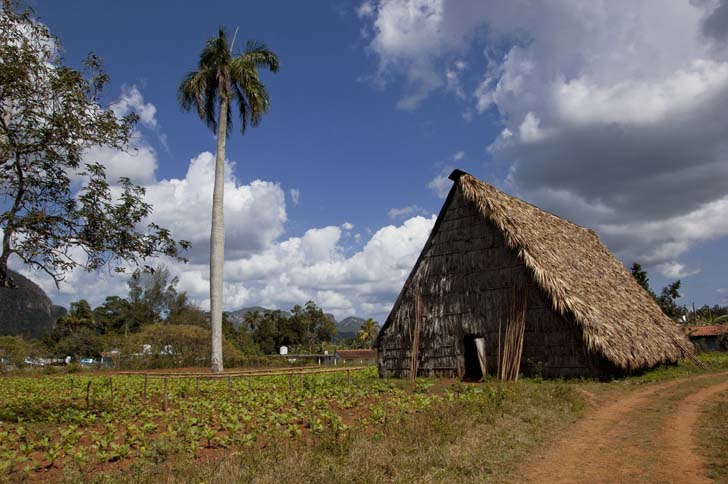
a lot of triangle houses without windows, these "Bohios" are
used for the drying of the tabaco leaves surrounded by palm
trees
It is easy
to drive from Habana to Pinar del Rio, because there is a
huge freeway to it. Under the bridges you will see hitch hikers
who would like to have a free ride home. For a foreigner it
will come in very handy to take a Cuban hitch hiker with you,
as he could show you the way, because of the lack of signs
at the road, and again, it is a fanastic occasion for meeting
locals.
hile
in the area, visit Jutia and Levisa Keys, off the nothern
coast, and the famous Vueltabajo tabacco fields, inland, where
the best tabacco in the world is grown. |
|
Cities and towns of interest
 Pinar del Rio City Pinar del Rio City
Capital
of the province of the same name, has museums of natural sciences
and history, the library which once belonged to the poet Dulce
Maria Loynaz del Castillo (winner of the Cervantes Prize in
1992), a distillery that makes Guayabita del Pinar ( a local
drink), a cigar factory with a House of Habanos, a House of
Rum, the Provincial Visual Arts Center and a Troubadours'
House.
Pinar
del Rio City |
 Vinales Vinales
The
province has several world-renowned natural attractions: Vinales
Valley, a part of world natural heritage, with impressive
pincushion hills with rounded tops. It also has one of the
most important cave systems in Latin America and several underground
rivers (one of which is navigable). The valley is an excellent
place for hiking, spelunking, bird-watching and other forms
of ecotourism, and the hotels blend in with their surroundings.
See the Mural of Prehistory and try the medical mineral water.
Vinales |
 Las Terrazas Las Terrazas
Las
Terrazas (pop. 1200), though not significant in terms of size,
it is certainly one the area's most interesting towns.
The
area's history of poverty began in the late 18th century when
coffee crops planted by French exiles from Haiti began to
fail. After that, the locals relied on sales of charcoal to
feed and clothe their families. Not only did they become appallingly
poor, but much of the area had been clear-cut, and was ecologically
dead. This area became one of the poorest in the province
of Pinar del Rio. |
The
town of Las Terrazas was founded in the early 1970's to provide
housing for the area's families. The town was designed with
good taste in mind, certainly a welcome change from the functional
but ugly Eastern bloc architecture (example) found in many
recent housing projects.
Besides
acting as a model community for progressive land uses and
ecological study, Las Terrazas has recently adapted itself
to host tourists. The type of tourism that this community
hopes to attract is different from that of other parts of
the country, however. The goal is to provide tourists with
an enjoyable stay at the park but not to surround them with
luxury. Thus, the biosphere provides many ways for tourists
staying at hotels near the town to enjoy the area's natural
beauty, such as hiking through the extensive network of trails,
and swimming in los Baños de San Juan. The model of
tourism for Las Terrazas also encourages interaction between
tourists and the people of the area. The overall effect is
to create an enjoyable tourist experience that is not loud,
nor obnoxious, and does not leave the Cubans feeling like
second-class citizens.
Even
for years after the Revolution, the area was still impoverished
and fully reliant on charcoal exports. The people of this
area were still isolated from the health care and education
that would be necessary to escape the cruel cycle of poverty.
In 1967, noting the area's horrid conditions, the government
established programs of rural development and ecological restoration
in an attempt to renew the community.
Similar
to the Agrarian Reform laws, and other projects around the
country, the people were provided with housing and employment.
In return, they were given the responsibility of working to
replant the area's forests. The area's export of charcoal
can now be considered a renewable resource, as only those
trees which are sick, dying, or overcrowded are used for charcoal,
and much replanting is done.
The
Sierra del Rosario world preserve of the biophere includes
Las Terrazas Tourist Complex, a rural community boasting
scores of craftsmen and artists the ruins of many old French
coffee plantations, rivers which are excellent for swimming,
an ecological hotel, well-conserved forests of notable biodeversity
which conyain many endemic species of trees, the Soroa orchid
gardens, with over 700 species of orchides from all over the
world and 100 from Cuba, in addition to around 6000 species
of other ornamental plants, and a beautiful waterfall 72 feet
(22 m) high. |
|
|
|
|
|
|